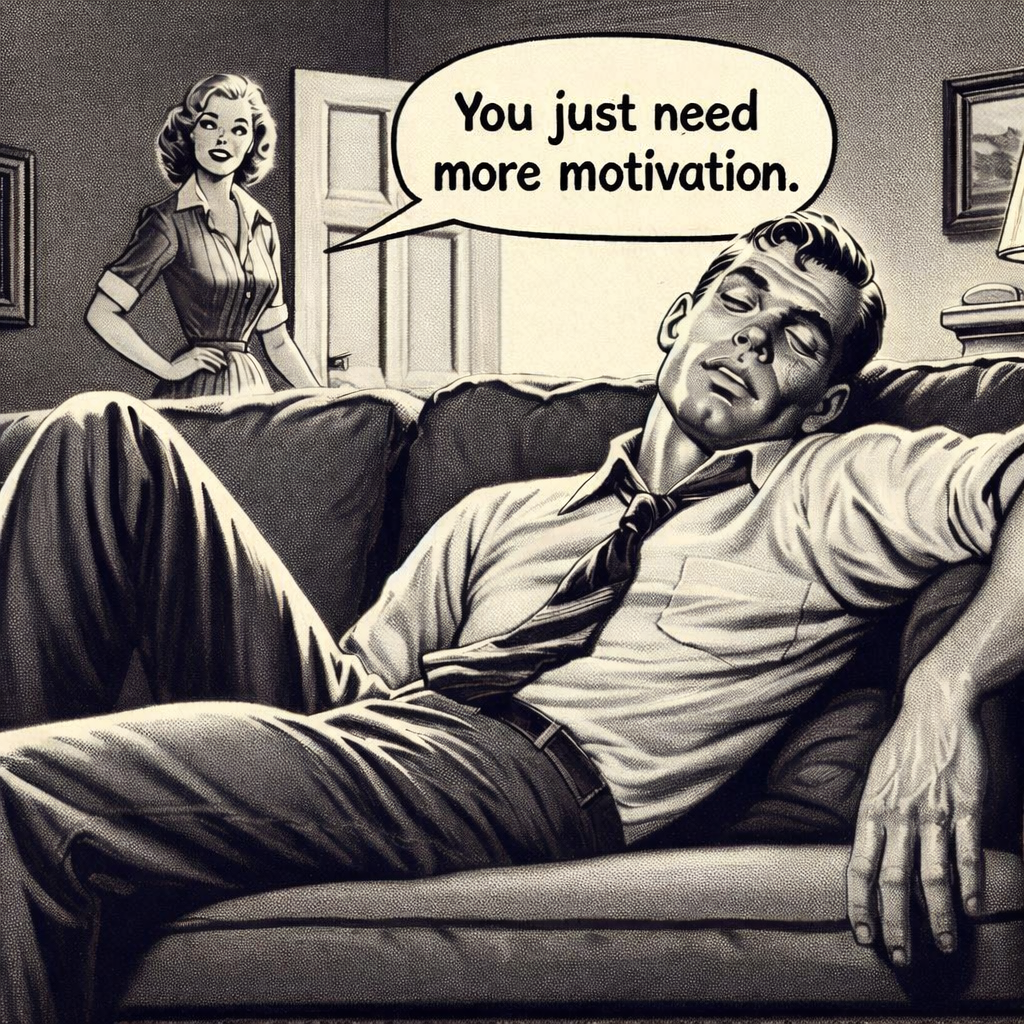
Most men think their problem is motivation.
They’ll say things like, “I just need to get my head right,” or “I’ll start when things settle down,” usually right after a long day and just before sitting down on the couch. I used to believe that too. The problem is, motivation has the reliability of a dodgy weather forecast. Sometimes it shows up. Most days it doesn’t. And if your progress depends on how you feel, you’re only going to move forward on your best days — which, as a father, aren’t exactly scheduled in advance.
What most men actually lack isn’t desire. It’s structure.
Structure is what carries you when motivation quietly slips out the back door. Think about the days when things actually go well — when you train, when you’re calmer, when you don’t snap at the kids over something small. It’s rarely because you woke up inspired and ready to conquer life. It’s usually because something was already decided for you. A routine. A time. A default. You didn’t have to negotiate with yourself, and that made all the difference.
Decision-making is exhausting, and most fathers are already making far too many decisions before breakfast. Work, money, family, schedules — by the time the day winds down, your brain is cooked. That’s when standards start to slip and reactions take over. Not because you don’t care, but because you’ve run out of bandwidth. Structure steps in right at that moment and says, “You don’t need to think about this — just do the next thing.”
That’s why disciplined men often look calmer than everyone else. Not because life is easier for them, but because fewer things require willpower. They’re not waking up wondering if they’ll train. They’re not arguing with themselves about bedtime. They’ve already made those decisions earlier, when they were clear-headed and not one minor inconvenience away from losing their patience.
And despite what it might sound like, structure isn’t about becoming rigid or boring. It’s about relief. It’s about removing the constant mental back-and-forth that drains your energy and leaves you frustrated with yourself. Structure gives you permission to stop having the same arguments with your own brain every single day — which, if you’re honest, you never really win anyway.
This matters even more when you’re a father. Because when the day collapses — when work has taken more than it should and the house is loud and everyone wants something from you at once — you won’t suddenly rise to your best intentions. You’ll fall to whatever systems you’ve built. And if you haven’t built any, you’ll fall to impulse. Impulse under stress rarely looks like the father you want to be, even if your heart’s in the right place.
The good news is, structure doesn’t need to be complicated. In fact, the simpler it is, the more likely you are to stick with it. A consistent wake-up time. A protected window for training. A clear way to shut the day down so work doesn’t follow you into the evening like an uninvited mate that conveniently turns up at every Sunday family BBQ. These small anchors don’t make life perfect — they just make it more predictable, and predictability is underrated.
This isn’t about becoming extreme or living like a monk. It’s about becoming reliable. Reliable for your family. Reliable for yourself. Because motivation asks, “Do I feel like it today?” Structure asks, “What’s next?” And when you know what’s next, you move — even when you don’t feel like it.
That’s how drift actually stops.
Not with hype.
Not with intensity.
But with structure — quietly doing its job in the background, while you get on with being a father.