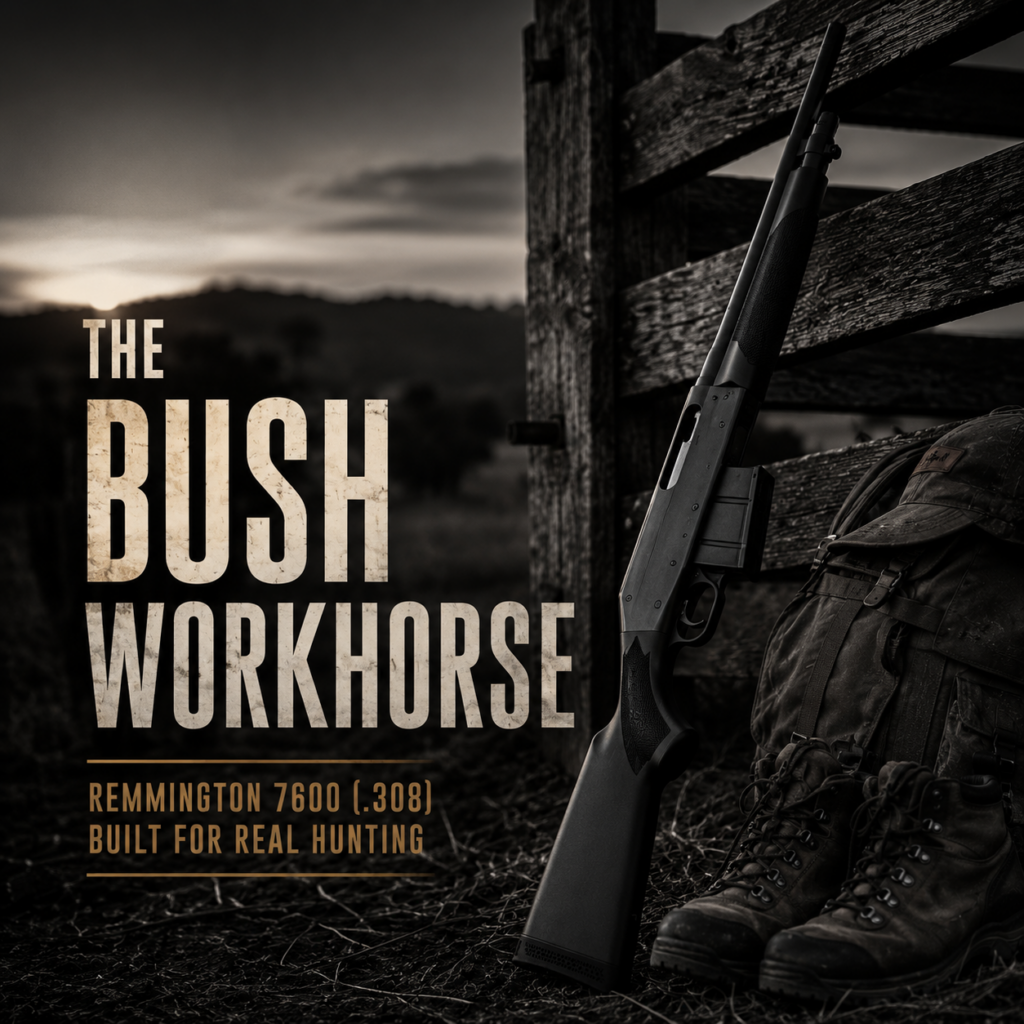
There are rifles that earn respect because they’re beautiful.
There are rifles that earn respect because they’re incredibly accurate.
And then there’s the Remington 7600, which earned its reputation by spending decades rattling around in ute racks, getting dragged through thick scrub, and putting meat in the freezer.
The 7600 isn’t glamorous. It never has been. You won’t find many hunters admiring one the way they admire a finely crafted walnut-stocked rifle or a custom long-range rig wearing enough optics to spot a kangaroo on the moon.
What you will find is a lot of hunters who have owned one, know someone who owns one, or have spent enough time in the bush to understand exactly why they became so popular.
Built for the Australian Bush
The Remington 7600 arrived in Australia at exactly the right time.
Hunters wanted a rifle that was fast, reliable, simple to operate, and chambered in cartridges capable of handling everything from goats and pigs through to sambar deer. The pump-action design offered something different from traditional bolt actions while avoiding many of the complexities of semi-autos.
The result was a rifle that could be operated quickly and instinctively, even when conditions weren’t ideal.
For hunters working thick gullies, dense scrub, and fast-moving game, that mattered.
A lot.
The ability to cycle another round without lifting your head from the stock became one of the rifle’s defining features and remains one of the biggest reasons people still buy them today.
Fast Follow-Up Shots
Let’s address the elephant in the room.
The biggest selling point of the 7600 has always been speed.
Whether you’re chasing pigs through lantana, working dogs in heavy country, or dealing with multiple animals moving through a clearing, the pump-action allows for rapid follow-up shots that many hunters find faster than a traditional bolt action.
It’s one of those rifles that seems to come into its own when things become slightly chaotic.
When an opportunity appears unexpectedly and disappears just as quickly, the 7600 has a habit of making its owners look more capable than they probably are.
That’s always a nice feature in a hunting rifle.
My Experience
I owned a synthetic-stocked 7600 in .308 Winchester for several years.
It was my first centrefire rifle and, at the time, seemed like the perfect all-round choice. Like many Australian hunters, I had dreams of chasing deer across mountain ranges and spending weekends exploring new country.
Over time, though, I realised something.
The 7600 and I wanted slightly different things.
The rifle excelled in situations where fast follow-up shots were important. Pig hunting in thicker country is where a rifle like this really shines. But my hunting style leaned more toward deer hunting, where a single deliberate shot was usually the goal.
As a result, I eventually found myself gravitating toward bolt-action rifles that better suited the way I hunted.
That isn’t a criticism of the 7600.
It’s simply a reminder that the best rifle isn’t always the best rifle. It’s the best rifle for how you hunt.
Accuracy: Better Than Some Claim
The Remington 7600 has occasionally developed a reputation for being less accurate than bolt-action rifles.
There is some truth to that.
A quality bolt-action will generally outshoot a standard factory 7600 when both rifles are placed on a bench and tested side by side.
But here’s the reality.
Most deer, pigs, goats, and other game animals aren’t shot from a concrete bench.
They’re shot from awkward positions, off sticks, leaning against trees, kneeling in grass, or trying not to breathe too loudly while your heart rate resembles a drum solo.
In real-world hunting situations, the 7600 is more than capable of delivering the accuracy required for ethical hunting at practical distances.
For most hunters, the limiting factor won’t be the rifle.
It will be the person behind it.
Myself included.
Recoil and Handling
One thing that surprised me was the recoil.
Despite not being particularly lightweight on paper, the synthetic .308 model always seemed to kick harder than I expected. Plenty of owners have made similar observations over the years.
It’s not unmanageable, but it certainly reminds you that you’ve touched one off.
Fortunately, the rifle balances well and handles naturally. The pump-action operation becomes second nature remarkably quickly, particularly for anyone who has spent time using shotguns.
Reliability Matters
One area where the 7600 has earned universal praise is reliability.
These rifles have a reputation for continuing to function despite dust, mud, rain, scratches, and the general abuse that comes with being a working hunting rifle.
They’re not delicate.
They’re not precious.
And that’s exactly why so many Australian hunters grew attached to them.
The 7600 isn’t the rifle you spend all evening admiring under soft lighting.
It’s the rifle you throw in the ute because tomorrow morning you’re heading into the bush.
Final Thoughts
The Remington 7600 occupies a unique place in Australian hunting culture.
It may not be the most accurate rifle on the market. It may not be the lightest. It certainly isn’t the newest design.
But decades after its introduction, hunters are still talking about it for one simple reason.
It works.
If your hunting involves thick country, moving game, and situations where quick follow-up shots can make the difference between success and a long walk home, the 7600 remains a compelling option.
For dedicated deer hunters who prioritise precision above all else, a quality bolt-action may be a better fit.
Neither choice is wrong.
They’re simply different tools for different jobs.
And like most things in life, success comes from choosing the right tool rather than the most fashionable one.