 IRON
Your program was written for a man who slept eight hours, ate well and had a quiet week. Some mornings that man turns up. Most mornings, if you’re a father, he doesn’t.
A sick toddler at 3 am. A deadline. A long shift, a sore back from carrying a sleeping kid up the stairs, a week where everything at home is loud. All of it draws on the same account your training does. Push hard on an empty account and you stall, get sick or get hurt. Skip every time you feel flat and you never build anything.
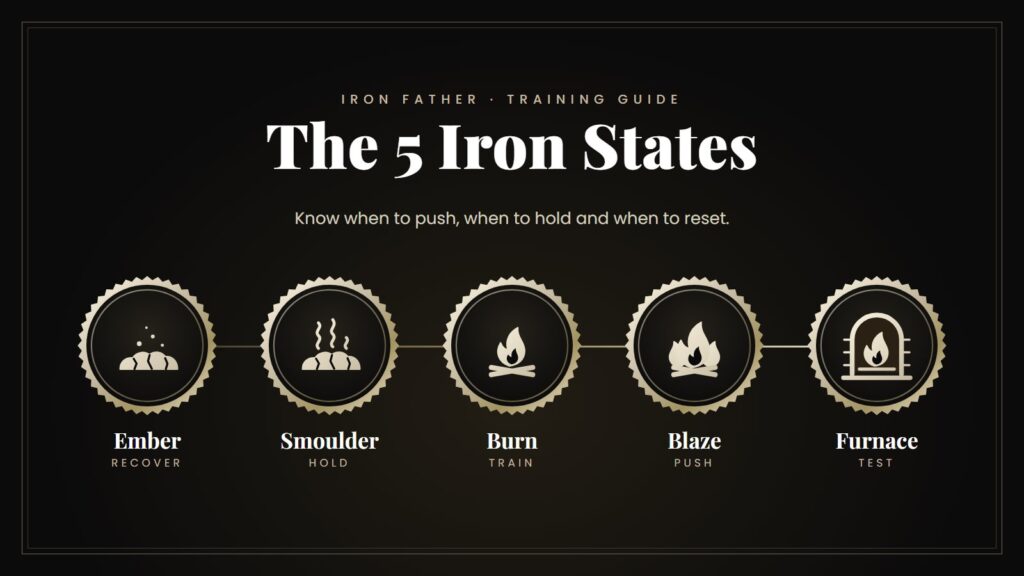
The 5 Iron States are the middle path. Each morning you take a two-minute reading of how you’ve recovered. That reading puts you in one of five states, and each state tells you what kind of session to train. You still turn up. You just train the right session for the day.
01 · The five states
From ember to furnace
Think of your recovery like a forge fire. Some days it’s barely glowing. Most days it burns steady. Every so often it roars. A good smith reads the fire before he strikes, and you should too.
| State | What it feels like | What you do |
|---|---|---|
| Ember | Wrecked, run down or barely slept | Recover. No lifting: walk, mobility, sleep. |
| Smoulder | Flat, sore or stressed | Hold. Train lighter, fewer sets, nothing heavy. |
| Burn | A normal day | Train the plan as written. |
| Blaze | Fresh, strong and keen | Push. Add weight or reps. |
| Furnace | Fresh, and you planned for it | Test. A heavy single or a rep max. |
02 · The morning check
Five questions. Two minutes.
Before your session (ideally first thing, before the coffee) score each of these from 1 to 5, then add them up.
| Question | 1 means | 5 means | |
|---|---|---|---|
| 1 | Sleep: how much, and how well? | Under 5 hours, or broken all night | 7 to 9 hours, woke up rested |
| 2 | Soreness: how do muscles and joints feel? | Very sore, stiff or limping | No soreness at all |
| 3 | Energy: how much fuel is in the tank? | Running on empty | Full tank |
| 4 | Stress: how heavy is life right now? | Overwhelmed | Calm and on top of it |
| 5 | Drive: how much do you want to train? | Dreading it | Can’t wait |
Find your state
- 5 to 10: Ember. Recover. No lifting.
- 11 to 14: Smoulder. Hold. A lighter version of the plan.
- 15 to 19: Burn. Train the plan as written.
- 20 to 25: Blaze. Push. Chase a little more than last time.
- 20 to 25, on a day you planned to test: Furnace.
Two overrides sit on top of the score. Any single score of 1 caps you at Smoulder, whatever the total: one terrible night or one angry joint is enough to hold back. And use the neck check for illness. A head cold above the neck (runny nose, mild sore throat) can still train at Smoulder. Anything below the neck (fever, chest cold, body aches, a stomach bug) is Ember, full stop.
Score the morning, not the excuse.
“I don’t feel like it” isn’t a state. Be honest in both directions: don’t talk a 2 up to a 4 to chase a heavy day, and don’t talk a 4 down to a 2 to dodge one. Most days the number will say train.
03 · State by state
What each state asks of you
Ember: recover
You barely slept, you’re run down or getting sick, or you’re so sore that normal movement hurts. No lifting today. Go for a 20 to 40 minute easy walk (a Silence Walk counts), do ten minutes of mobility, eat a proper meal and get to bed early. Write it in your log as a session done. An ember still glows: recovery is training.
Smoulder: hold
Flat, heavy legs, short on sleep, or a stressful stretch at home or work. Train the planned session, but lighter: drop the weights by 10 to 20 percent or cut a third of the sets. Stop every set with three or four reps left in the tank. No new bests, no finishers, and aim to be done in under 45 minutes. You keep the habit and the movement patterns without digging the hole any deeper.
Burn: train
A normal day. Not perfect, not broken. Train the plan as written, finishing most working sets with one to three reps in the tank, and add weight or reps wherever the plan says to. This is where most of your sessions should live. Progress isn’t built on heroic days. It’s built on ordinary Burn days stacked week after week.
Blaze: push
You slept well, nothing is sore and the bar feels light in the warm-ups. Train the plan, plus a push: add 2.5 to 5 kg to your main lift or one or two reps per set. Take one top set to a single rep in the tank, and add an extra back-off set if it’s still moving well. Push, don’t max. A Blaze day banks progress. It isn’t a licence to test everything.
Furnace: test
A Blaze-level score on a day you set aside to test. Never stumbled into. Warm up thoroughly, then work up to a heavy single, triple or rep max on one lift, with a spotter or safety arms. Stop when bar speed dies or form breaks. Keep the accessory work short and plan a Smoulder day after. Once every three to four weeks is plenty.
04 · How hard is hard?
Reps in the tank
Each state sets how hard your sets should be, measured by how many more clean reps you could have done when you racked the bar.
| In the tank | How it feels | Used in |
|---|---|---|
| 4+ | Easy, smooth | Smoulder, and every warm-up |
| 2–3 | Working hard | Burn: most of your sets |
| 1 | Very hard, bar slowing | Blaze: one top set |
| 0 | Couldn’t do another | Furnace only, with a spotter |
05 · Reading the pattern
One day is weather. A week is climate.
A single Smoulder day means nothing. The pattern over a week or two tells you whether your training, sleep and life are in balance.
- Three Smoulder or Ember days in a week: take a deload week (same exercises, half the sets, lighter weights). Check your sleep and food first.
- Mostly Smoulder for two weeks: your split may be more than your recovery can carry. Drop a training day or move to a simpler split. Select Your Split walks you through the options.
- Blaze three sessions running: you’re ready. Plan a Furnace day in the next week.
- Ember twice in a fortnight with no clear reason: a new baby or a sick house explains it. If nothing does, book in with your GP.
Red flags: don’t train, get checked.
Chest pain or pressure, unusual breathlessness, dizziness or fainting, a fever, or sharp pain in a joint (not muscle soreness). These aren’t a low score. They’re a reason to stop and see a doctor.
06 · Write it down
Your state belongs in the Ledger
Write your score and state at the top of each training diary page, before the first set. After a month you’ll see your own patterns: which days of the week run low, what a short night really costs you, and how often you genuinely have a Blaze in you.
On Six Months to Legend, the states slot straight into the rhythm. The Iron Wake is the time to take the reading, the weekly recap in the Legacy Ledger is where you spot the pattern, and your monthly Trial is a Furnace day you plan for.
Print it. Stick it on the garage wall.
The morning check, the score table, all five states, the reps-in-the-tank guide and a 28-day state log in one free printable PDF.
The fire doesn’t burn the same every day, and it was never meant to. The father who reads it honestly, morning after morning, is the one still training in ten years.
Train the man who showed up today.
This guide is general fitness information, not medical advice. If you have an injury or health condition, or you’re new to training, check with your GP or a qualified trainer first.
One response to “The 5 Iron States: Know When to Push, Hold or Rest”
[…] selfish when other people depend on you. It’s part of the job. (If your fire keeps burning low, the 5 Iron States will help you find out […]